
Posted by Dr Hannah Bunting
31 March 2026Adam Gray gives his preview of the 2026 local elections in the capital, where Labour are being challenged by multiple parties.
Local Elections 2026 Preview: London
By Adam Gray
Every council seat in 32 London boroughs is up for election on Thursday 7th May, alongside directly elected mayors in five. The last time they elected, in 2022, Labour won a majority on 21 London councils, the Conservatives won five, there were three Liberal Democrat-run boroughs, Residents gained one, and one had no party in overall control. This time, we’re expecting to see substantial change.
One phenomenon that has only been picked up recently began in 2022. Whilst Labour generated headlines by winning the formerly Conservative boroughs of Barnet, Wandsworth and Westminster, they also lost three of their bellwethers: Croydon (and its elected mayor), Harrow and Tower Hamlets. In ethnically diverse, safe Labour wards, there were some big swings away from the party. Beneath the headlines was an early flag of a growing rupture between Labour and a demographic central to its success in London – ethnic minorities.
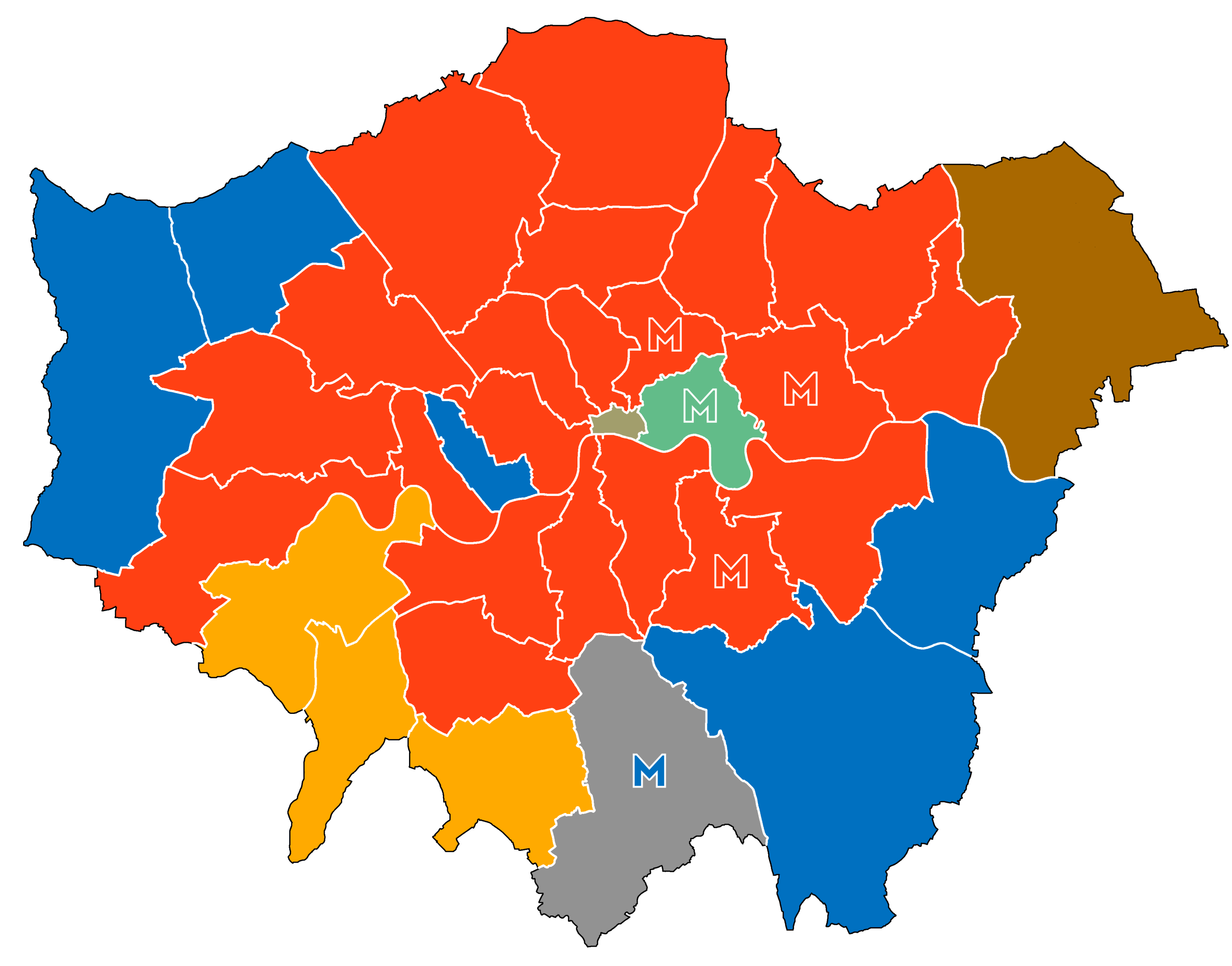
London Boroughs and their control following the 2022 local elections
This rupture has, of course, deepened following the Gaza conflict, Labour’s tougher positioning on immigration, its struggle to boost the supply of affordable housing, plus all the other sources of dissatisfaction with the government the polls have been highlighting. Though not enough for them to lose seats in 2022 due to their large majorities (apart from in Harrow and Tower Hamlets), if these trends continue in 2026, we will see cracks in Labour’s London red wall appearing in unusual places: Brent, Hounslow and Ealing in the West, and Newham, Redbridge and Barking in the East.
The capital was once an exemplification of two-party Britain. When the Conservatives tanked in the polls, Labour was the sole beneficiary, and vice versa. But this changed substantially last time Labour was in government – they lost close to 200 London seats in both 2002 and 2006, the latter year seeing the emergence of new parties winning wards.
Twenty years on, that fragmentation will be even more visceral. The Greens are expecting great results in inner London, and Reform UK should do well in the outer East. We could also see an assortment of Independents doing well in boroughs like Redbridge and Newham, boosted by left-wing ex-Labour councillors who left the party disillusioned by Keir Starmer’s leadership.
This will make the elections difficult for Labour – and it will be worse because their fall is from high: 2018 and 2022 were their best London results since 1971: they won 1,156 councillors. 2026 could see Labour win many fewer London seats than their 684 in 2006.
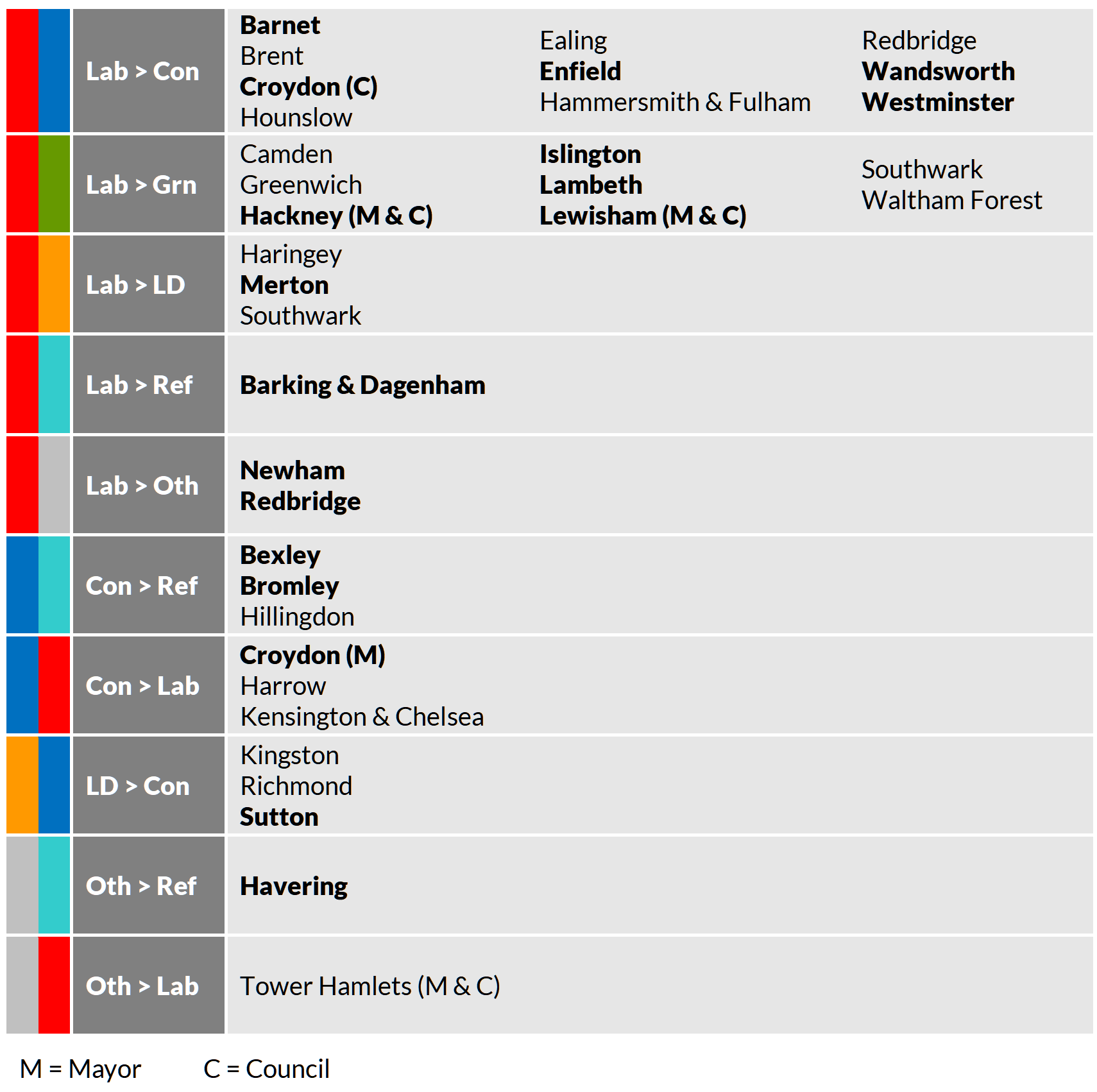
The principal challenger to the incumbent in each London borough – councils in bold are ones where there is a realistic prospect of the incumbent losing power
Nowadays the principal party threat is not the only threat. The Greens are trying to win footholds in most London boroughs – certainly most inner London boroughs. And their targets offer insights into how their tactics are evolving.
Many of the wards the Greens are targeting were among Labour’s safest in 2022: Harrow Road and Westbourne in Westminster; Golborne and Colville in Kensington and Chelsea; White City in Hammersmith and Fulham. These are areas Labour hasn’t really ever had to fight to hold – ethnically diverse, huge amounts of council housing, quite deprived.
Previously we might have expected a demographically attractive ward for the Green targeting to be affluent, middle-class, liberal and environmentally conscious, formerly Conservative-voting. Parts of Richmond, Hampstead, Hammersmith and central Wandsworth, for example. They may win in these areas anyway but they are directing their campaigning aggression at Labour.
There is often more than one threat to the incumbent. The Liberal Democrats are the main opposition to Labour in Haringey but they have repeatedly struggled to break through on the Tottenham side of the borough (where the Greens are credible challengers). They also remain strong at the Bermondsey end of Southwark, but the challenger in Peckham and Dulwich is likely to be the Greens. Camden has at least four parties likely to win seats, maybe some Independents too.
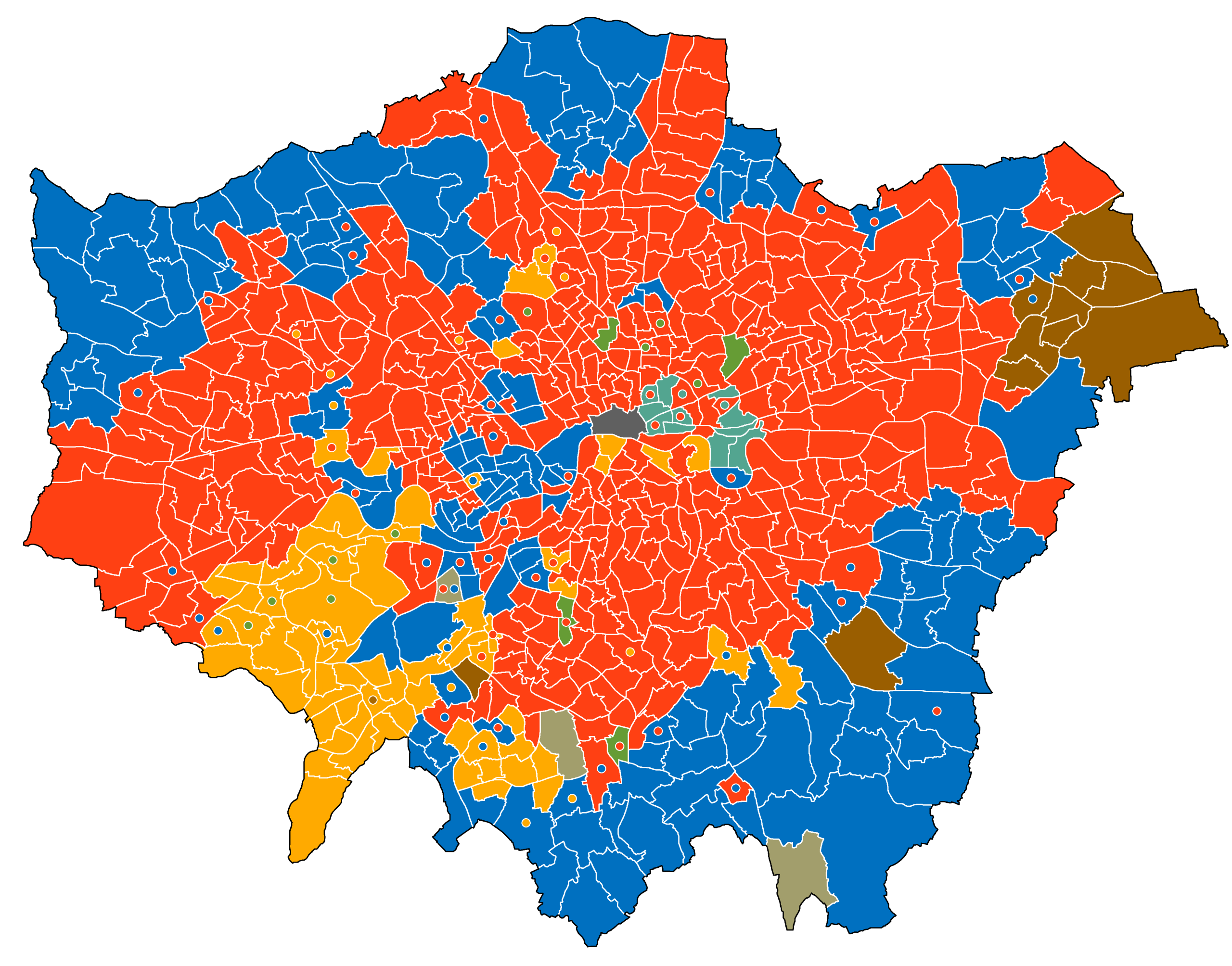
London wards and their control following the 2022 local elections
As inner London turns Green, parts of outer London will probably turn Reform’s light blue. Their top target is Kentish Bexley, still a very white borough atypical of London. Havering on the Essex border is as promising but complicated in local elections by a deeply-embedded Residents’ Association that has been around since the 1950s. Barking & Dagenham voted Leave in the EU referendum but has changed demographically since. Reform could still win in Dagenham and on the vast Becontree council estate, but it’s difficult to beat Labour in a borough they’ve never lost. Harder still is Bromley, where they could remove the Conservative majority without being able to win themselves, and then Hillingdon. There will probably be Reform councillors in Croydon and perhaps Sutton and Redbridge, but it’s hard to see the party encroaching into inner London.
The Conservatives do still have some strength in London and will appeal to those who feel over-taxed and getting little bang for their buck. A decade on from the EU referendum they will hope the Brexit backlash in largely Remain-voting London will be ebbing. There seems to have been a swing from Labour to Conservative in London since 2022 of around 4-6% — the March YouGov poll had the swing among its London sub-set as high as 8%.
Any noticeable swing should be enough for Wandsworth, Westminster and maybe Barnet to return to the Conservatives. But they are highly unlikely to get the sort of uplifts needed to win boroughs they would once have in a Labour mid-term, such as Hammersmith and Fulham, Ealing or Merton.
A feature of last year’s local elections was councillors winning with fairly low vote shares. That will probably recur this year and should lead to more of London’s multi-member wards electing councillors from different parties. Just shy of seventy wards “split” in 2022 (out of 679). There will be unexpected winners.
There will be many more London boroughs under no overall control after May 7th. The Greens have been open to working with other “progressive” parties but they exclude Labour from that definition. So, if Labour majorities vanish it will be harder for them to stay in power. It may also be more difficult to rebound in 2030 as Londoners become more comfortable with the more competitive, diverse electoral battleground 2026 is likely to usher in.
For a look at London borough by borough, see my preview of the 2026 elections here.
 View our parent website (electionscentre.co.uk)