

Posted by Dr Hannah Bunting
21 April 2026Adam Gray gives the first of a two-part preview on Greater Manchester, asking whether Gorton and Denton will realign the region.
2026 Local elections preview: Greater Manchester part one
By Adam Gray
Greater Manchester is electing 215 representatives across 10 councils this May. The sheer scale means two parts to the blogposts for the region, this one looking at the City of Manchester itself plus the four boroughs to the east: Rochdale, Oldham, Tameside and Stockport. In light of the recent parliamentary by-election where the Greens beat both the incumbent Labour and a confident Reform, the question remains whether Gorton and Denton will realign Greater Manchester.
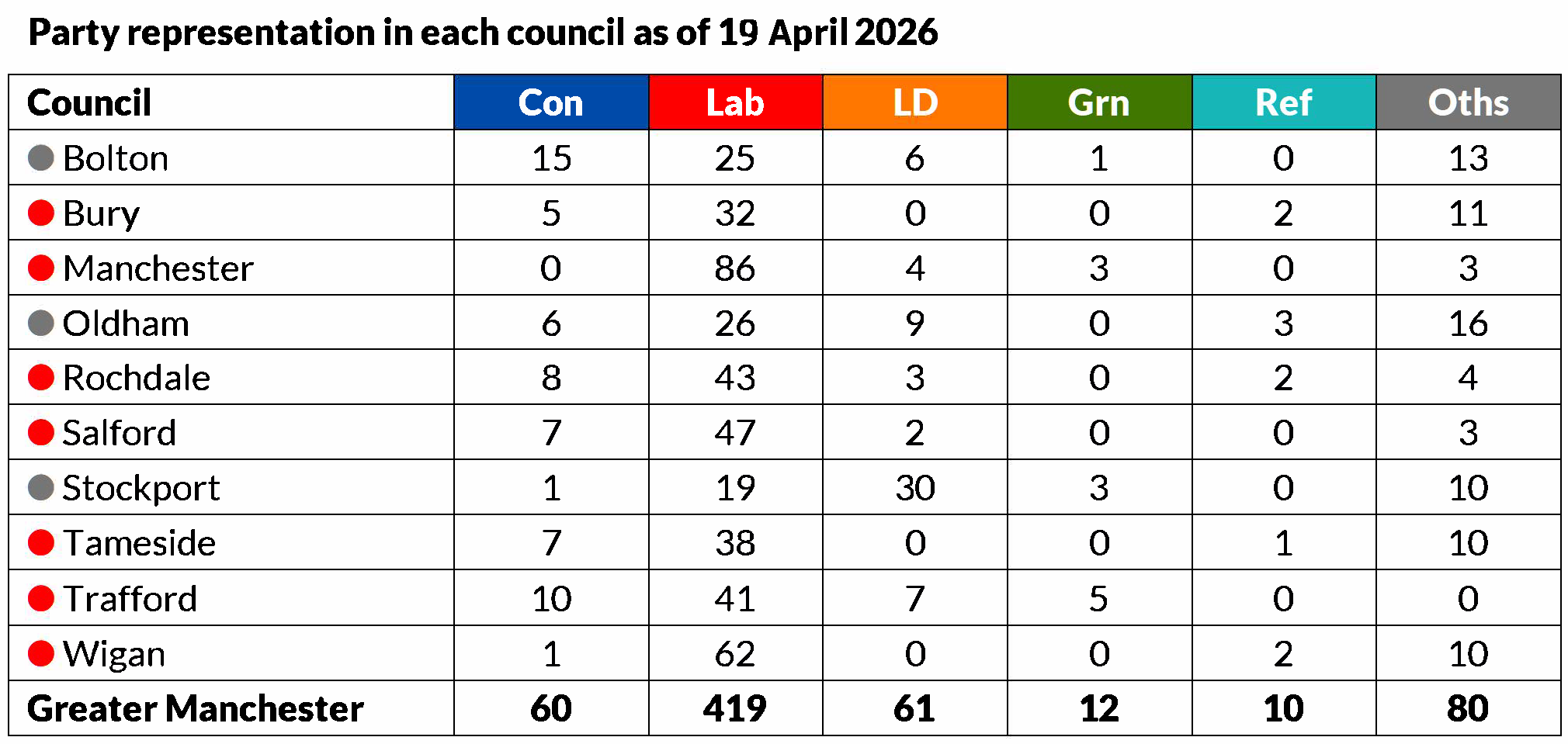
It seems an aeon ago that the Conservatives made headway into Greater Manchester, winning constituencies like Leigh, Bury South, Bolton North East and Heywood & Middleton. But those days are gone: there are no longer any Conservative MPs in this county; Conservative control of Bolton, Bury and Trafford is fading into memory. There are more Labour councillors in Wigan than there are Conservatives in the whole county. It’s going to be pretty hard for the Conservatives to fall further – though they may well manage to.
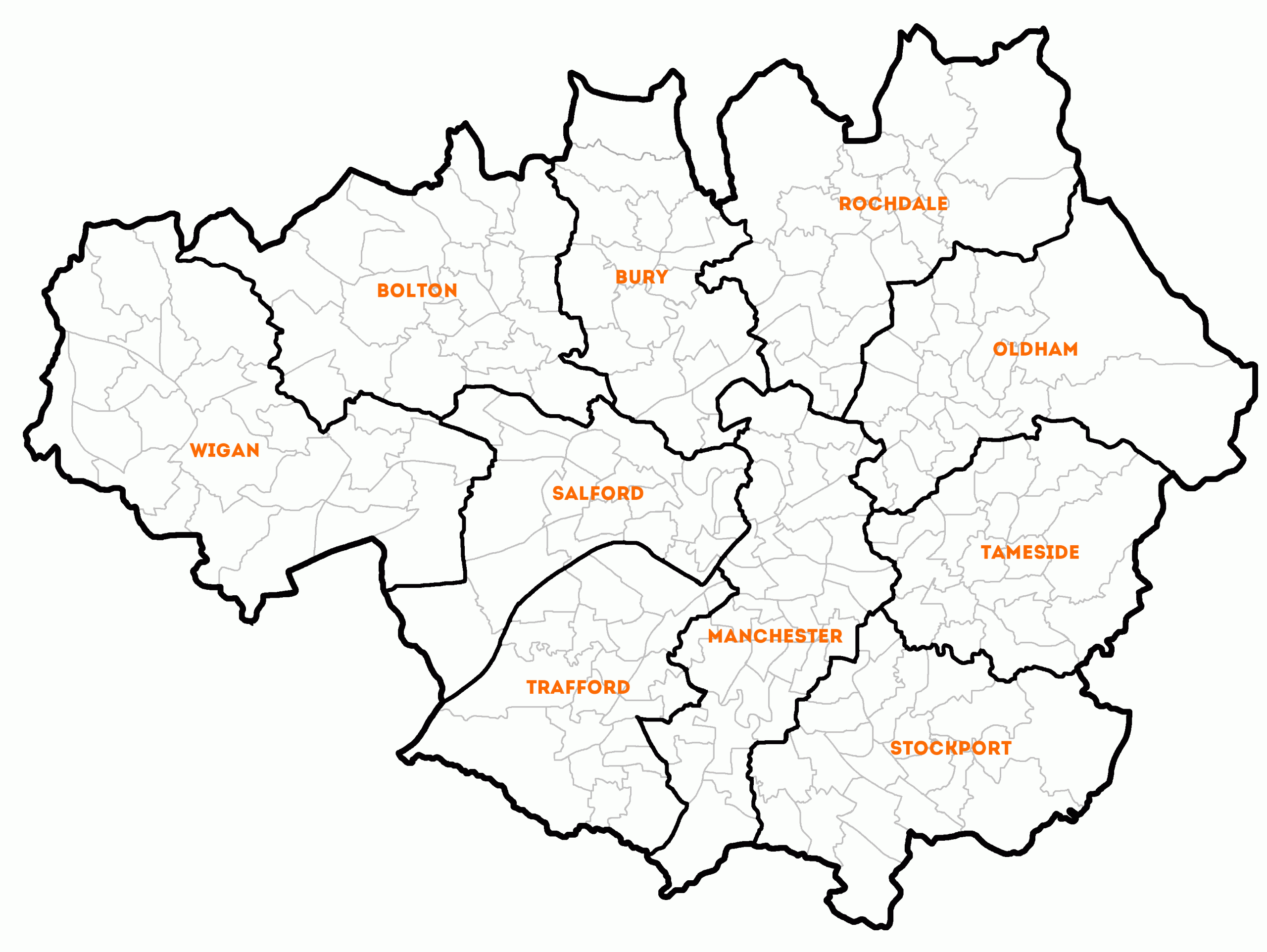
Greater Manchester councils map
It’s a different story for Labour. They hold two thirds of the seats so their exposure to losses is huge.
Manchester looks like one homogenous red Labour blob, but that’s a misconception. Steeped in the history of both the lower-case labour movement and the Labour party, the city contains all of the demographic groups that form Labour’s coalition. There’s the huge, largely white working class council estate constituency of Wythenshawe in the south. There is the relatively affluent suburban strip including Chorlton, Didsbury and Withington. Then there are the two sides of the city centre: the outer ring including Gorton which houses much of the city’s ethnically diverse electorate, and the growing inner core of new residential towers and student digs. Plus Blackley in the north, similar to Wythenshawe in the south demographically, but a neighbourhood with a longer history and closer to the city centre.
Labour’s problem is that they aren’t holding onto those voters. They are under threat from Greens, Community Independents and the Workers’ Party in student-heavy wards and those with large Muslim populations. Either the Greens or the Lib Dems can assail them in the affluent southern suburbs, while Reform has a decent shot in Wythenshawe and Blackley. Of the 32 seats up in the city of Manchester this year, Labour defends 30.
The boroughs east of the city are of a somewhat different character to the ones to the west. The Pennines-side of Greater Manchester has historically been where the Liberal Democrats and their predecessors have thrived. They have at various points controlled Rochdale and Oldham, and they currently run Stockport.
This side of the county also has larger Muslim communities than are found west of Manchester because of the mills that powered the local economy. The west had more heavy industry and, of course, mining. George Galloway won one of his by-election breakthroughs in Rochdale before the 2024 general election as a protest against the Gaza crisis. Labour won it back at the general election but two Workers Party councillors won at the 2024 locals.
The other half of Rochdale borough is mostly the towns of Middleton and Heywood, and both will be Reform targets. Labour could get caught in a pincer: losing here to the right and the centre of Rochdale to the left. But with a council majority of 26 and only 14 of their seats up, Labour should be able to just about hold on.
They’ve already lost Oldham. There was a bigger Gaza-related backlash here in 2024: Labour lost six seats to Gaza Independents and control of the council. This was a chaotic election with seats also falling to Independents with priorities other than Gaza. But this year will be even more turbulent with Reform’s arrival. They will likely be strongest beyond Oldham itself: in Chadderton, Failsworth, Royton, Crompton and Shaw. If Labour loses more seats in Oldham town to Independents and outlying wards to Reform they will likely not even remain the largest party on the council – which may create an ungovernable mess.
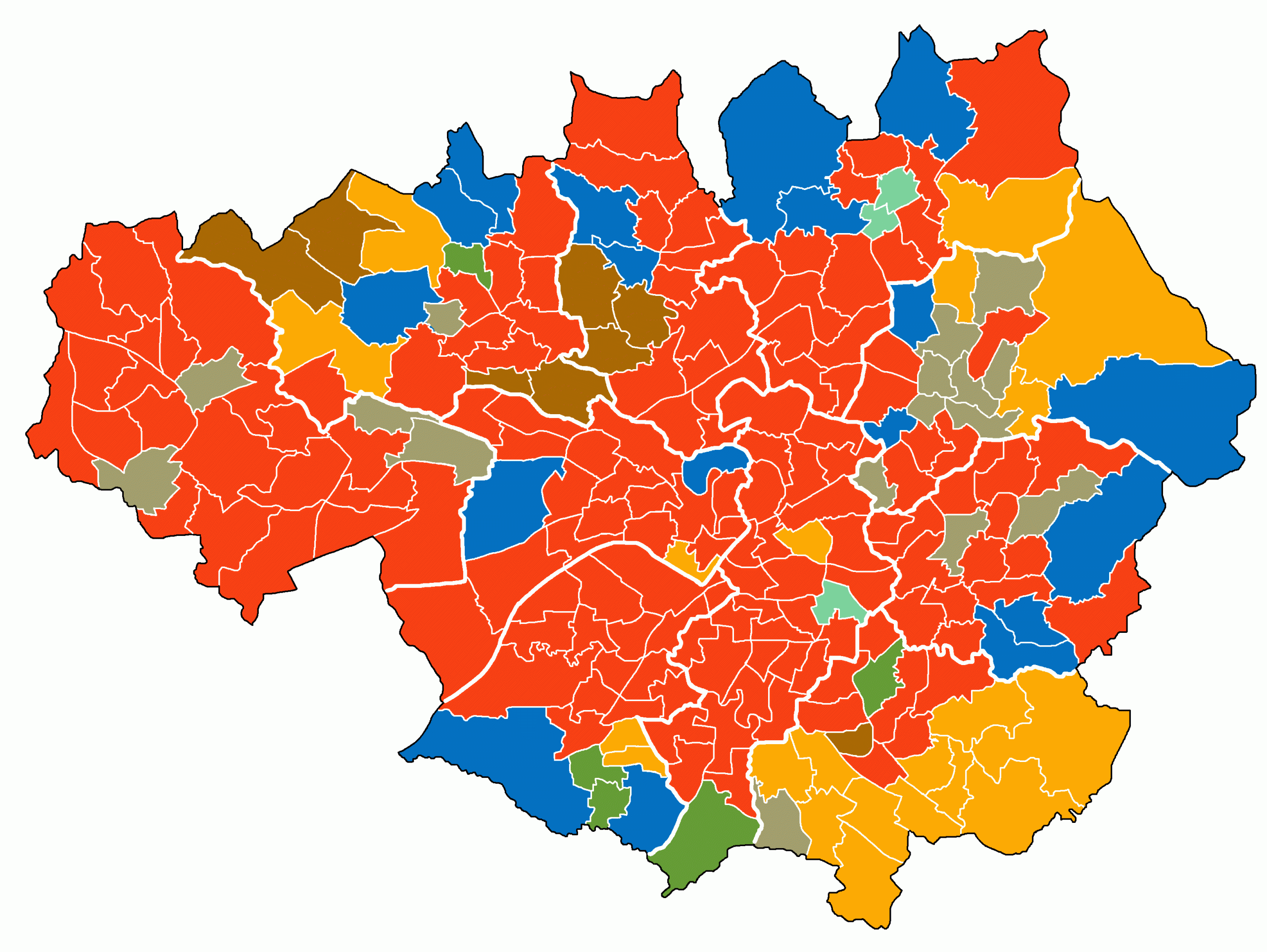
Greater Manchester wards by winning party after the 2024 local elections
Tameside is, or was until Gorton and Denton, a bit of a backwater: very safely Labour but with no big, dominant town as the rest of Greater Manchester has (bar Trafford). As well as Denton it covers Ashton-under-Lyne, Hyde, Stalybridge and Droylsden, all working class dormitory villages beyond Manchester.
But aside from an already Reform-leaning demographic, Labour created huge problems for itself with the scandal that led to February’s by-election. Some Tameside councillors were involved with former MP Andrew Gwynne’s insulting WhatsApp group, where Labour’s 39-seat majority has been halved due to suspensions. Fourteen Labour seats are up for election plus three Independents.
Reform “won” all three Denton wards in the by-election; they will likely sweep most of the rest of Tameside this time. It’s roughly evens whether Labour loses their majority: something that’s never before happened.
Finally Stockport. The constituency is safe Labour – so why isn’t the council? Stockport is just one third of the borough, and the other parts, Hazel Grove and Cheadle, are very much not Labour. These are affluent suburban and semi-rural wards, the Lib Dems have dominated them in local elections for decades.
Right now a big gap has opened up: 30 Lib Dems, 19 Labour, 3 Greens, 10 Independents and a Conservative. 32 are needed for a majority. They’re tantalisingly close but the Lib Dems may just fall short – there is only one Labour defence in a ward the LDs won in 2024. The Lib Dems also need to fend off the Conservatives in outlying Bramhall.
This isn’t great territory for Reform but there may be a couple of Labour-held wards they could attack. The Greens may be more of a threat. They already hold Reddish South, which is next door to Gorton, and there are surrounding Labour wards that are similar demographically.
Labour can’t win Stockport unless they take Lib Dem wards and the Lib Dems can’t win until they can beat Labour in Stockport town. The fragmented electoral landscape may help them by enabling them to win seats on a low vote share they otherwise couldn’t, or it could suck anti-Labour votes that might have lined up behind them off to other parties of protest. The Lib Dems will continue in power, with or without a majority.
Part two will consider the competitive west of Greater Manchester. Across the region, there is a fierce battle for representation. Labour defend two thirds of the seats against their many challengers.
 View our parent website (electionscentre.co.uk)